


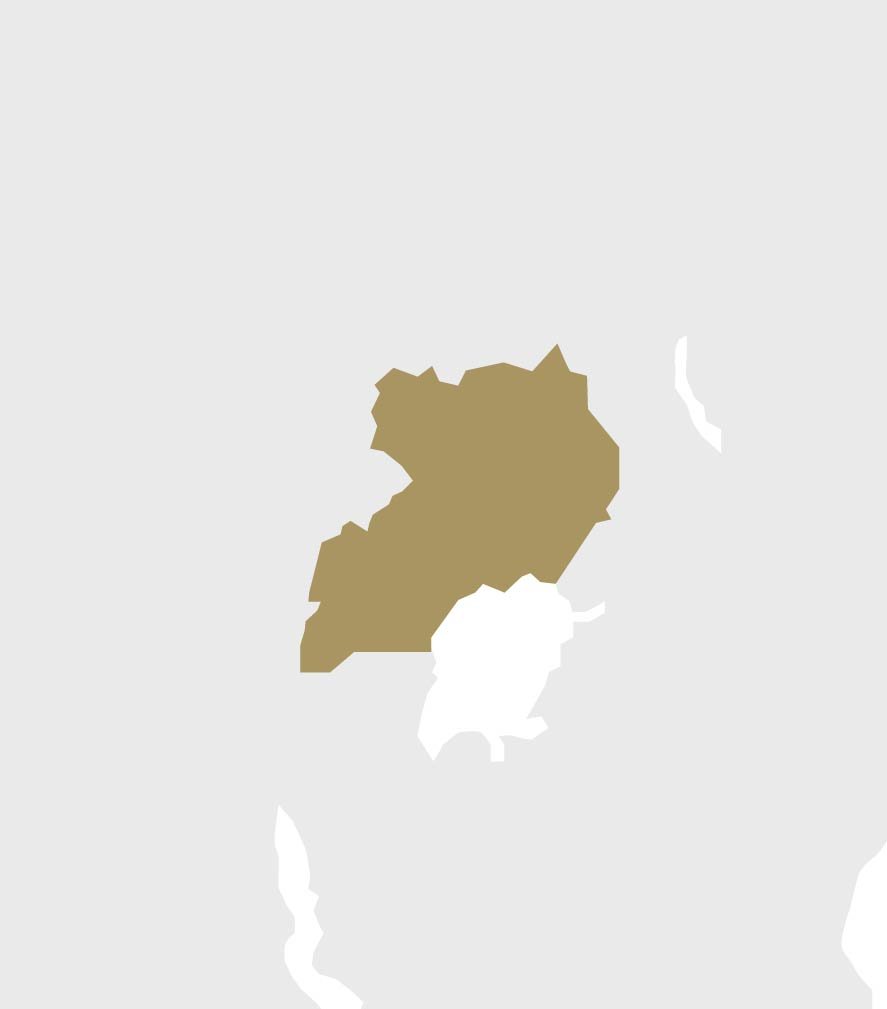
The Republic of Uganda is a landlocked country and one of the most populous countries in Africa with a population of almost 50 million people, most of whom live in rural areas.
Uganda has diverse natural landscapes, national parks, and wildlife, and is home to Lake Victoria, Africa’s largest lake.
Uganda gained independence in 1962, joining the United Nations the same year. The country has experienced periods of instability, most notably during Idi Amin’s presidency in the 1970s and as a result of actions of the rebel group known as the Lord’s Resistance Army (LRA) formed in the late 1980s.
Uganda has a growing economy, with the World Bank expecting brisk real GDP growth in the coming years fuelled by the development of the oil sector. Climate change will continue to negatively impact the country, in particular the agriculture sector. There are deepening concerns around shrinking political and civil spaces with elections scheduled for January 2026. Uganda has one of the world's youngest populations, with over 90% of people under the age of 30.
Ireland has been working in Uganda since 1994. This work involves partnering with the Ugandan government, European Union, UN, and NGOs, as well as local communities. Ireland continues to focus on developing its political, economic, development, trade, and cultural relationships with Uganda, and has an active Irish community working in the private sector, with INGOs and multilateral organisations, and missionaries.
Ireland prioritises access to education, inclusive governance, climate action, and gender equality and inclusion.
Uganda in focus
While Uganda’s economy continues to grow, multi-dimensional poverty persists. This is particularly the case in the Karamoja region, which has been a focus of Ireland’s development cooperation in Uganda since 2004. Many Karamojong rely on subsistence agriculture and livestock herding. The effects of climate change and drought have contributed to sustained food insecurity while unemployment and the threat of conflict are ongoing challenges for the region.
School enrolment rates in Uganda have improved significantly this century. However, school closures during the COVID-19 pandemic presented renewed challenges. Ensuring pupils complete primary education remains a priority for the Government of Uganda and for Ireland.
Based on a generous open-door policy, Uganda hosts nearly 2 million refugees and asylum seekers, mostly from Sudan, South Sudan, and the Democratic Republic of the Congo (DRC). This is more than any other country in sub-Saharan Africa.
The country is rich in natural resources such as cobalt and copper. In 2014, the Ugandan government founded the Uganda National Oil Company, to develop and establish the country as an oil-producing nation.
Ireland’s Aid work in Uganda
Ireland's development work in Uganda covers five key areas:
Education
Ireland works with a range of partners to address barriers to education, primarily in Karamoja. We provide bursaries to students, support skills training, and provide school meals. Ireland works with UNICEF to improve the quality of education for vulnerable children and boost school enrolment and results.
Ugandan students are invited to apply to the Ireland Fellows Programme. This programme provides bursaries to study at postgraduate level at universities in Ireland.
Inclusive governance
Ireland works to promote and support good governance, accountability, and human rights by supporting effective governance institutions, including protecting and enhancing civil society space. Ireland partners with Denmark, the Netherlands, and Sweden, as well as a variety of local and international organisations to deliver the Programme on Accountability, Civic Engagement and Rights (PACER).
Climate action
In 2024, Ireland began working with the UN Capital Development Fund (UNCDF) on the LoCAL project to support local governments and communities in adapting to climate change. It works by providing performance-based climate resilience grants that fund local adaptation projects, which are identified by the communities themselves. The project also includes capacity building and technical support to integrate climate resilience into local planning and budgeting. The LoCAL mechanism is jointly funded by various international partners and the Government of Uganda.
Refugees
With almost 2 million refugees, Uganda faces significant humanitarian and development demands. Ireland supports the refugee response with a focus on building resilience and self-reliance. We fund the UN Refugee Agency (UNHCR) and the World Food Programme (WFP) to support refugees.
This support focuses on cash transfers, food assistance, and protection of women and children.
Gender equality and sexual reproductive health and rights
Gender-based violence remains a persistent issue in Uganda and the Karamoja region has the highest fertility and maternal mortality in the country. Women are at high risk of dying in pregnancy or childbirth. Improvements have been made in under-five mortality rates. Ireland is contributing through the establishment of the Moroto Blood Bank to provide life-saving blood transfusions, and by funding projects for maternal and child health, and supporting women's groups and education. Additionally, Ireland supports efforts to end Female Genital Mutilation (FGM) in Karamoja and work to end violence against women and children.
Social protection
Ireland provides support for the delivery of social protection programmes in Uganda. We particularly focus on senior citizens, in line with our goal to prioritise the most vulnerable in society.
Ireland also supports civil society organisations and groups who advocate for vulnerable and marginalised communities in Uganda.
We provided support to the response to an outbreak of Ebola in Uganda in 2025. The outbreak was declared over in April of that year but we continue to support surveillance and health systems strengthening.