


Disarmament and Non-Proliferation
Achieving a world free of nuclear weapons and promoting disarmament of conventional weapons and arms control are priorities for Ireland.
What we do
Ireland is committed to working to achieve a more peaceful, secure and prosperous world. We recognise that the spread of weapons of all kinds fuels conflict, contributes to human rights abuses, and hinders development. Promoting disarmament, therefore, is one of five signature foreign policies for Ireland and builds upon Ireland's historic legacy in this area.
From our early efforts at the United Nations in the 1950s, which led to the creation of the Nuclear Non-Proliferation Treaty (NPT) in 1968, to our more recent work on the humanitarian impact of the misuse of conventional weapons, Ireland continues to play a leading role in efforts to promote disarmament, non-proliferation and the regulation of new weapons.
Ireland is party to a number of international agreements that seek to eliminate certain categories of weapons, or ensure that their spread and use is controlled. Further information on these agreements can be found in the sections below.
In recent years, Ireland has also played a leading role in bringing the horizontal issue of gender and disarmament to the fore in international negotiations, given the need to ensure greater women’s participation in all disarmament-related discussions and negotiations.
Nuclear weapons and other WMD
Nuclear disarmament
Achieving a world free from the threat of nuclear weapons is an historic, long-standing priority for Ireland. Motivated by the immense human suffering which would arise from the detonation of a nuclear weapon, whether by accident, miscalculation or design, we are working for the complete elimination of these weapons.
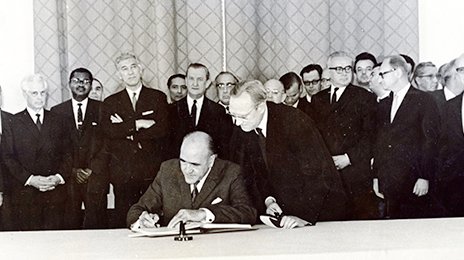
Ireland has consistently been in the vanguard of the move for nuclear disarmament since we joined the UN over sixty years ago. The origins of the Treaty on the Non-Proliferation of Nuclear Weapons (NPT) are closely connected with Ireland. In 1958, led by then Minister Frank Aiken, Ireland introduced the first of what became known as the ''Irish Resolutions'' at the UN which eventually led to the NPT. In recognition of this pioneering role, Ireland was the first country invited to sign the NPT in 1968, and it entered into force in 1970. The NPT is the cornerstone of the nuclear disarmament and non-proliferation regime.
In 2017, Ireland played a leading role in the process that led to the adoption of the Treaty on the Prohibition of Nuclear Weapons (TPNW). Ireland views the TPNW as complementing the NPT, which always envisaged further effective measures on nuclear disarmament. The TPNW includes a comprehensive set of prohibitions on participating in any nuclear weapon activities and represents the successful outcome of the first multilateral nuclear disarmament negotiations in over 20 years. It is the successful outcome of many years of work by committed states, civil society partners, and mostly the survivors of nuclear weapons use and testing. Ireland was a member of the 'Core Group' of States which initiated the TPNW process, together with Austria, Brazil, Mexico, Nigeria and South Africa.
Ireland enacted the Prohibition of Nuclear Weapons Act 2019 to give effect to the TPNW in Irish law. Ireland deposited its ratification of the TPNW on 6 August 2020, a date which also marked the 75th anniversary of the bombing of Hiroshima.
New Agenda Coalition (NAC)
Ireland is a member of the New Agenda Coalition (NAC), a cross-regional group of States committed to promoting progress on nuclear disarmament. Ireland played a central role in the coalition's formation in 1998 and remains committed to its objectives alongside fellow members Brazil, Egypt, Ireland, Mexico, New Zealand and South Africa.
Ireland is a member of the Conference on Disarmament and last served as President of the conference between June and August of 2024.
International Atomic Energy Agency (IAEA)
The International Atomic Energy Agency remains central to global efforts to prevent nuclear weapons proliferation and promote the safe, secure and peaceful uses of nuclear technologies. Ireland has chosen not to include nuclear power in its energy mix. However, we remain committed to promoting and facilitating the peaceful uses of nuclear technology within the NPT context and under appropriate international safeguards. We have been a member of the IAEA since 1970 and we work with its Member States and partners worldwide to protect the peaceful uses imperatives of the NPT.
Comprehensive Nuclear-Test-Ban Treaty (CTBT)
Ireland regards the Comprehensive Nuclear-Test-Ban Treaty as an important means to promote and implement the objectives of the NPT. The CTBT would prohibit nuclear test explosions, thereby drawing a clear line between peaceful and military uses of nuclear technology.
The Treaty will only enter into force when all of those countries listed in Annex 2 to the Treaty, which were nuclear-capable when the treaty was agreed, ratify it. Ireland is committed to promoting its early entry into force and calls upon the remaining Annex 2 countries - now nine in total - to ratify immediately and without conditions.
Chemical and biological weapons
We are not only committed to achieving a world free of nuclear weapons, but are also playing an active role towards eliminating all categories of weapons of mass destruction. Achieving a world free from the threat of all weapons of mass destruction is a longstanding priority of Irish foreign policy.
Ireland has been party to the Chemical Weapons Convention (CWC) since its entry into force in 1997 and to the Biological Weapons Convention since 1972. For the past sixteen years, the CWC has made considerable progress towards eliminating an entire weapons category from global arsenals. Since September 2025, there are 193 State Parties to the convention. Ireland played a key role in shaping the EU contribution to the Third Review Conference of the Chemical Weapons Convention in The Hague in April 2013. During 2022-2024, Ireland served a two-year term as a member of the Organisation for the Prohibition of Chemical Weapons Executive Council
Call for action: UN panel on nuclear effects
In 2024, the UN General Assembly resoundingly adopted a resolution led by Ireland and New Zealand to establish a scientific panel to examine the effects of nuclear war. The panel will work until 2027 on the physical and societal consequences of nuclear war. It will publish a comprehensive report – accessible to all – that ties together the interconnected impacts that would result from such a war. This is the first such UN-mandated study since 1989, and will take into account significant scientific progress since then, including improved climatic and environmental modelling. It will conduct research into seven areas:
- Nuclear and Radiation Studies;
- Atmospheric Sciences and Climate;
- Earth and Life Sciences;
- Environment and Environmental Studies;
- Agriculture, Biology and Life Sciences;
- Public Health and Medicine;
- Behavioural and Social Sciences and Applied Economics.
21 leading scientists from a range of disciplines sit on the panel, chosen through a rigorous selection process.
The Panel met for the first time in New York in September 2025, and elected its co-chairs: Professor Ana María Cetto Kramis of Mexico and Professor Andrew Haines of the UK. Ireland’s Dr. Neil Rowan, Professor in the Faculty of Science and Technological Health at The University of the Shannon, is a member of the Panel.
Conventional Weapons
Explosive Weapons in Populated Areas (EWIPA)
On 18 November 2022 Ireland welcomed delegates from across the world to a high-level international conference in Dublin to adopt a Political Declaration on Strengthening the Protection of Civilians from the Humanitarian Consequences arising from the use of Explosive Weapons in Populated Areas. Ireland is an active supporter of multi-stakeholder efforts to further the universalisation and national implementation of the EWIPA Political Declaration. The number of countries adopting the EWIPA Political Declaration continues to increase. For the latest figures consult Endorsement — UNODA.
The declaration marks the culmination of almost three years of consultations led by Ireland, involving UN Member States, the United Nations, the International Committee of the Red Cross (ICRC) and civil-society organizations, including the International Network on Explosive Weapons (INEW). The declaration's focus is to address the devastating and long-lasting humanitarian impact of the use of explosive weapons in populated areas.
Cluster Munitions
Ireland is proud that the text of the Convention on Cluster Munitions (CCM) was agreed at a Diplomatic Conference in Dublin in May 2008. The CCM was the most significant development in international humanitarian law since the Ottawa Convention banning anti-personnel landmines was agreed a decade earlier. The heart of the Convention is an immediate and unconditional ban on all cluster munitions which cause unacceptable harm to civilians.
Each State Party undertakes never in any circumstances to use, develop, produce, acquire, stockpile, retain or transfer cluster munitions, or to assist another party in doing so.
An important innovation and feature of the Convention are the provisions which address the needs of victims, in line with its similar predecessor the Anti-Personnel Mine Ban Treaty.
Ireland is closely identified with the CCM, and continues to see its successful implementation and universalisation as a priority.
Ireland has taken leading roles furthering the convention by working as the co-ordinator on Clearance from 2011-2013, acting as the Coordinator of the Victim Assistance Committee in 2017 and our ongoing support to the CCM Implementation Support Unit.
Landmines
Ireland was part of the core group of countries which drafted the Anti-Personnel Landmine Convention (APLC) and was among the first States to sign and ratify it in March 1997.
The Convention not only prohibits the use of anti-personnel landmines, but also commits States to assist in the removal of mines from mine-affected countries. Not only does this work prevent further casualties, it also allows land to be released for agriculture and business, directly contributing to longer-term stability and economic development.
Ireland has provided over €65m since 2006 towards demining, including funding for work in Afghanistan, Angola, Cambodia, Iraq, Lao PDR, Mozambique, Ukraine, Vietnam and Zimbabwe. Ireland remains committed to mine action.
Ireland is a proud champion of the UN Secretary General’s 2025 campaign on mine action and humanitarian disarmament to promote the Anti-Personnel Mine Ban Convention (APMBC).
Other Conventional Weapons
The Arms Trade Treaty (ATT) was adopted by the UN General Assembly in 2013 to regulate the International trade in conventional arms and to establish mechanisms to begin eradicate the illicit trade and diversion of conventional arms. The ATT entered into force in 2013 and Ireland ratified the treaty in April 2014.
The ATT covers the major categories of conventional arms, including the small arms and light weapons which proliferate in conflict afflicted states and non-conflict afflicted states with high levels armed violence and very high civilian casualties.
Ireland is an active and engaged participant in discussions through the ATT, including acting as facilitator in 2025 of a sub-working group under the Working Group on Effective Treaty Implementation that is focused on current and emerging implementation issues.
The Convention on Certain Conventional Weapons (CCW) prohibits the use of specific weapons that are considered to cause unnecessary suffering or that indiscriminately affect both civilians and military personnel, including lethal autonomous weapons systems. It is for this reason that Ireland signed the Convention in 1981, the same year that it opened for signature.
Ireland is engaged in active negotiations to agree a set of elements of an instrument to address these weapons through working with the Group of Government Experts (GGE) on Lethal Autonomous Weapons Systems (LAWS) under the CCW. The GGE has a mandate until the next CCW Review Conference in 2026.
Export Controls
Export Control Regimes
The effective enforcement of export control regimes is a core component of upholding Ireland's international non-proliferation obligations.
As a member of multiple disarmament and non-proliferation treaties and conventions, Ireland has a responsibility to ensure that adequate domestic controls are implemented in order to prevent the proliferation of weapons of mass destruction and conventional weapons.
To assist us in meeting our obligations under these treaties and conventions, Ireland is a member of a number of export control regimes.
- The Nuclear Suppliers Group is a group of nuclear supplier countries established in 1974. It seeks to contribute to the non-proliferation of nuclear weapons through the implementation of guidelines for nuclear and nuclear-related exports, governing the transfers of civilian nuclear material and nuclear-related equipment and technology to non-nuclear-weapon States.
- The Wassenaar Arrangement was established in order to contribute to regional and international security and stability, by promoting transparency and greater responsibility in transfers of conventional arms and dual-use goods and technologies, thus preventing destabilising accumulations. The aim is also to prevent the acquisition of these items by terrorists.
- The Zangger Committee aims to assist States Parties to the Nuclear Non-Proliferation Treaty in preventing the export of nuclear-related strategic material and equipment to non-nuclear-weapon States which may be used for weapons proliferation.
- The Missile Technology Control Regime (MTCR) is an informal political understanding among states that seeks to limit the proliferation of missiles and missile technology. The MTCR seeks to limit the risks of proliferation of all types of weapons of mass destruction (WMD) by controlling exports of goods and technologies that could support their delivery systems. Ireland and Iceland co-chaired the MTCR October 2017-2018.
- The Australia Group is an informal forum of countries which, through the harmonisation of export controls, seeks to ensure that exports do not contribute to the development of chemical or biological weapons. Formed in 1985, the group now has 43 members.
The Department of Enterprise, Trade and Employment, has responsibility for licensing in Ireland. We work closely with that Department on applications for the export of military goods and certain dual-use goods from Ireland.
Ireland is a member of the Nuclear Non-Proliferation Treaty, The Treaty on the Prohibition of Nuclear Weapons, The Biological and Toxin Weapons Convention, Chemical Weapons Convention, the Arms Trade Treaty, The Comprehensive Nuclear Test Ban Treaty, The Convention on Certain Conventional Weapons, The Cluster Munitions Convention and the Anti-Personnel Landmine Convention.
Civil Society Engagement and Outreach
Ireland is pleased to work with strong international partners including Article 36, Reaching Critical Will, the European Leadership Network and Chatham House (International Security Programme).
Ireland believes that work in disarmament and non-proliferation processes is more effective when there is strong cooperation between states and Civil Society. Ireland is pleased to work with strong international partners including Article 36, the International Campaign to Abolish Nuclear Weapons (ICAN), Handicap International and Reaching Critical Will.
Recognising the importance of rigorous research in disarmament work, Ireland also works in partnership with the United Nations Institute for Disarmament Research (UNIDIR), and closely with the UN Office for Disarmament Affairs.