

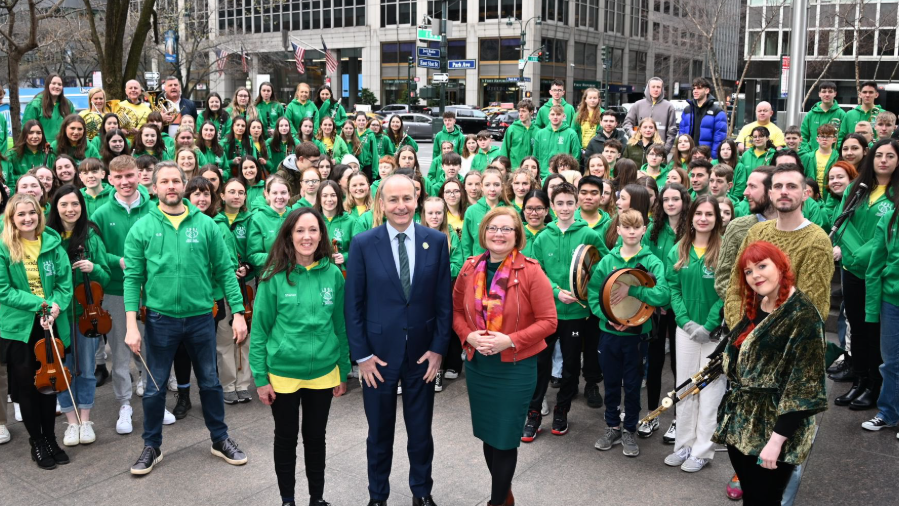
Emigrant Support Programme
Working through hundreds of organisations across the world, the Emigrant Support Programme focuses primarily on two areas:
- support for the vulnerable and underrepresented
- nurturing Ireland’s cultural heritage abroad among the diaspora.
The 2026/27 grant application window will open on Thursday, 15 January and remain open until Wednesday, 4 February 2026.




The Irish Abroad Unit in the Department of Foreign Affairs and Trade manages and coordinates the Emigrant Support Programme.
Since its establishment in 2004, the Emigrant Support Programme (ESP) has assisted more than 900 organisations in 51 countries. Grants issued to date total over €265 million.
Individual grants have ranged from small amounts for grass-roots groups to major allocations awarded to voluntary and community organisations operating on a large scale.
This work is conducted in partnership with Ireland’s Embassies and Consulates together with a large number of Irish organisations abroad.
The funding year runs from 1 July until 30 June the following year. The application window for the Emigrant Support Programme opens every January for approximately three weeks.
On this page you'll find:
Grant round 2026/2027
The application window for the 2026/2027 Emigrant Support Programme funding is open from Thursday, 15 January 2026 to Wednesday 4 February 2026.
Small Grants Scheme
There is a separate application form for organisations seeking total funding of €30,000 or less (or local equivalent as per table below). This Small Grants Scheme involves a shorter application form with less reporting throughout the year.
The criteria for both ESP streams remains the same.
| Region | Amount in local currency |
|---|---|
| Britain | GBP £26,000 |
| United States | USD $35,000 |
| Canada | CAD $45,000 |
| Australia | AUD $50,000 |
| Rest of world | EUR €30,000 |
Categories of funding
ESP projects must align with the objectives of the Government’s Diaspora Strategy 2020-2025.
The categories under which ESP can be applied for are as follows;
- Heritage - projects involving the promotion and maintenance of Irish heritage and identity overseas, such as Irish sports, Irish music, Irish dance and other arts.
- Community care - projects involving the provision of front-line welfare services including advisory, counselling, information and outreach services to Irish communities.
- Business networks - projects to support Irish business networks or other Irish professional networks overseas.
- Capital - projects involving the construction, refurbishment or purchase of capital assets. This includes projects related to website development and large digital/software projects.
Organisations may make applications in more than one category.
>>Read frequently asked questions
Eligibility criteria for funding
- Applicant organisation is established as a registered charity, charitable body or voluntary/not for profit organisation.
- Project meets one or more of the objectives of the ESP.
- Project addresses any of the areas highlighted in the Government’s Diaspora Strategy 2020-2025.
- Appropriate governance arrangements are in place for oversight and administration of funding.
- ESP requirements have been met.
Evaluation is based on the following criteria:
- The need for the project.
- Beneficiaries in the Irish community (including second and later generations), their needs and vulnerabilities.
- The impact of the project, based on clear expected outputs and outcomes.
- Partnerships with other statutory, voluntary and ESP-funded organisations to maximise service delivery to vulnerable Irish people.
- How the outcomes will contribute to the achievement of ESP’s objectives.
- The capacity of the organisation to deliver the project.
- The total project cost and value for money offered.
- What funding has been secured from other sources for the project.
- The monitoring and evaluation systems in place to measure the outcomes for target beneficiaries.
- Commitment to good governance and best practice throughout the organisation.
Ineligible costs
While each application is considered on its merits, in general Emigrant Support Programme funding cannot be used to support:
- Fees or expenses of artists, performers or speakers, including travel and accommodation – professional or otherwise
- Personal study or travel abroad
- Repayments of loans or deficits
- Party political activities
- Commercially driven projects
- Costs of attending Embassy or Consulate events
- Purchase of prizes for raffles
- Membership fees for other ESP-funded organisations
- Purchase of vehicles
- Taxes, rates and other statutory charges
- Private pensions
- Costs for the applicant organisation’s own promotional merchandise
- Catering costs (except for events for seniors e.g. lunch clubs)
>> Further information frequently asked questions
Required documentation
Applicants are responsible for ensuring that applications meet ESP requirements, and that all required supporting documentation has been submitted at the time of application. Incomplete applications will be withdrawn from the grant process.
All funding decisions are based on the information submitted in the official application forms. Applications must be submitted online through our grant portals. No hard copy application forms will be accepted.
Required documentation:
- Mandatory - Recent (fiscal year/calendar year) financial statements
Copies of the most recent annual accounts, which the organisation was obliged to submit to the relevant local and/or national regulatory authorities in order to comply with statutory financial and accounting regulations in its country of operation. Signed and dated by the Treasurer and another Board/Committee member.
Where annual accounts are not yet available/required, the following should be provided at a minimum:
An up to date annual Income and Expenditure account that includes a statement of assets and liabilities. Signed and dated by the Treasurer and another Board/Committee member, on headed official paper.
Organisations with no annual income, i.e. newly formed organisations:
Declaration of no income/expenditure signed and dated by the Treasurer and another Board/ Committee member (on headed official paper), along with evidence of a bank account, e.g. copies of bank statement.
- If applicable - A copy of the organisation’s Child Protection Policy/Vulnerable Person Policy
Safeguarding is a fundamental part of creating safe environments for individuals, particularly vulnerable groups such as children, care-recipients, and those with disabilities.
– To protect vulnerable people from harm
– To prevent crime and exploitation
– To promote equal opportunities
– To build trust and confidence
– And to uphold legal obligations
The Department of Foreign Affairs and Trade expects grantees to follow best practice in relation to safeguarding. Safeguarding policies are required if your organisation works with, engages with and/or provides services to children or vulnerable adults, including organising/hosting public-facing events.
Organisations must ensure that they also comply with the requirements regarding the protection of children and vulnerable people in place in the country in which they are providing or will provide a service. It is the responsibility of grantees to ensure that processes and procedures are in place and are being followed by both their own staff and volunteers as well as any on-granted partners.
Safeguarding policies:
(i) must be discussed and agreed by the Board;
(ii) must be signed and dated by at least two members of the Board;
(iii) should be reviewed annually by the Board, and revised when required, to ensure compliance with best practice and legal requirements;
(iv) most recent policy, signed and dated, must be included with the ESP application
- Mandatory - Details of Board Members
In addition, grant recipients must clearly acknowledge ESP funding in their accounts and on their websites.
>> Further information Writing your ESP application
Capital projects applications
Capital funding is dependent on the overall availability of funds. Please consult your nearest Consulate or Embassy before applying for large-scale capital projects.
Applications are considered for projects involving the construction, refurbishment or purchase of capital assets which will benefit Irish communities abroad. This includes projects related to website development and large digital/software projects.
Capital grant applications must be accompanied by the following documentation:
- A project plan with clear timelines and budget overview clearly demonstrating that a significant portion of the cost of the project has been secured from sources other than the Emigrant Support Programme
- Three separate competitive quotes for the intended project
As a general rule, premises in respect of capital projects should be owned rather than leased or rented.
Other Supporting Documentation
If you have any additional documentation that may support your application you can also attach to your application. This may include: Strategic Plans; Annual Reports; Newsletters; Photographs.
Principles governing recipients of Irish government funding
The ESP is funded through taxpayer’s money and is therefore public funding. The highest levels of transparency and accountability are applied. Reports on the impacts and the success of projects funded and financial reports are required as part of the ESP process.
In line with regulations governing the receipt of grants from the Irish Government, all grantees must strive for:
Clarity
Set out clearly the objectives, inputs and outputs of their funding spend:
- Show clearly that funding was spent only for the business purposes for which it was provided
- Seek clarification from the grantor where necessary – on use of funds, governance and accountability arrangements.
Governance
Ensure appropriate governance arrangements are in place for oversight and administration of funding:
- control and safeguarding of funds from misuse, misappropriation and fraud
- accounting records which can provide, at any time, reliable financial information on the purpose, application and balance remaining of the public funding
- accounting for the amount and source of the funding, its application and outputs/outcomes.
Value for money
Be in a position to provide evidence on:
- effective use of funds
- value achieved in the application of funds
- avoidance of waste and extravagance.
Fairness
Manage public funds with the highest degree of honesty and integrity:
- Act in a manner which complies with relevant laws and obligations e.g. tax, minimum wages
- Procure goods and services in a fair and transparent manner
- Act fairly, responsibly and openly in dealings with the grantor.
Additional points to note
It is recognised that it may not be possible to immediately begin a project which has been approved for funding. However, it is expected that the project will have commenced within six months of receipt of the grant. Irish Government accounting practices require the money to be used for the approved purpose within the same funding year.
The funding year runs from 1 July each year until 30 June the following year.
- Grant aid not used in accordance with the terms and conditions specified by the Irish Government must be repaid in full
- If a grant has been awarded towards funding for a staffing position and a vacancy arises in that position during the funding year, organisations should expect to refund for the period the position was unfilled
- Contact your nearest Embassy or Consulate or email diaspora.affairs@dfa.ie if you have questions about your project's eligibility for ESP funding.
We look forward to working with you to deliver tangible benefits for Irish communities, wherever in the world they may be.
Contact details
For any queries about the Emigrant Support Programme please contact your local Embassy or Consulate, or email diaspora.affairs@dfa.ie.