


Kenya Young Scientist Programme: Empowering the next generation of STEM innovators
Young Scientists Kenya (YSK) is a unique Science, Technology, Engineering, and Mathematics (STEM) initiative in Kenya, that aims to inspire and empower the next generation of innovators and entrepreneurs to transform their local and global communities.
The programme is active in all 47 counties across Kenya country and , YSK works primarily with secondary school students [both junior and senior] from public schools. The programme’s goal is to , and has a ‘leave no learner behind’ campaign that’ and thus focuses on students from Arid and Semi Arid areas (ASALs), special needs schools, and refugee schools.
Young Scientist Kenya offers students an opportunity to explore and develop their interests in science and is keenly supported by the support from the Embassy of Ireland, the Ministry of Education, Kenya, and other key stakeholders in STEM from Government, Academia, and the Private and Public sector.
The 2024 YSK exhibition brought together 220 students from 107 schools across 45 counties, including participants from the Kakuma Refugee Camp and Rusinga Island. Co-hosted with the National Research Fund’s inaugural National Research Festival, this event spotlighted student innovations focused on climate change solutions through STEM.
Students present their projects at the annual exhibition in Kenya, with an overall winner selected by judges. The winners then have the opportunity to come and visit Ireland for the BT Young Scientist Exhibition held in the RDS every year. At the 2025 exhibition, the 2023 and 2024 YSK winners visited Ireland to display their projects on an international stage, alongside the Irish and Jordanian counterparts.
Meet the 2024 overall winners
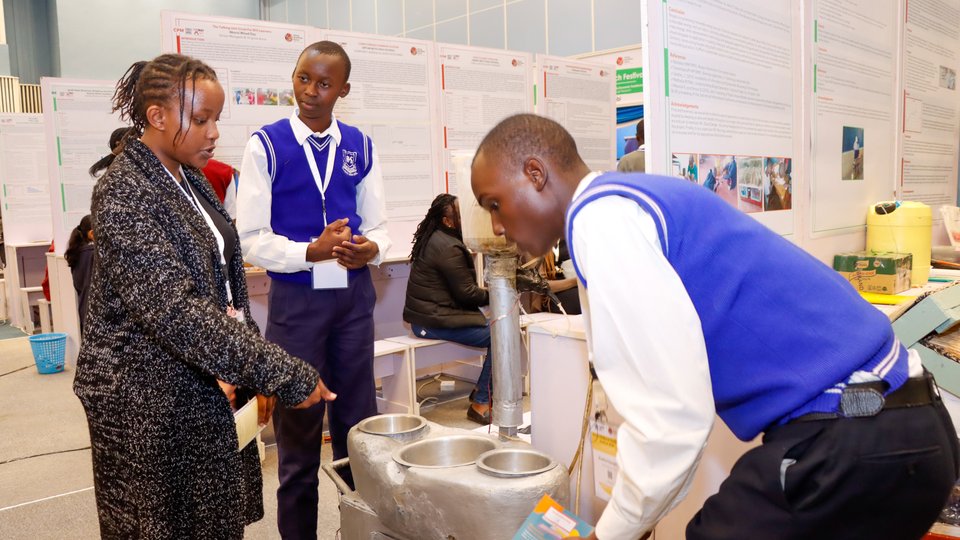
Bradford Nyangiri and Felix Makori came out on top at the 2024 YSK. They come from Nyamira County and developed a cost-effective, eco-friendly, and energy saving improvement on the traditional jiko, made from local materials.
Their project, entitled ‘The Sunken Cooking Jacket’, focused on the inefficiencies of charcoal burners and created a more sustainable, efficient and cost effective cooking machine. The improved jiko focuses on minimising heat loss, channelling and neutralising harmful fumes, reducing cooking time, and enhancing comfort and safety in indoor cooking environments.
By improving insulation and functionality, the proposed solution aims to lower energy costs, reduce environmental impacts, improve public health, and enhance domestic and industrial cooking efficiency, ultimately supporting sustainable energy use and resource conservation.
Renewable energy is essential for sustainable development, yet billions of people in developing countries still rely on inefficient traditional biomass fuels like wood, charcoal, and agricultural residues for cooking and heating.
These practices contribute to forest degradation, increased greenhouse gas emissions, and indoor air pollution, posing environmental and health risks. Despite investments in energy technologies, adoption remains limited.
Meet the 2023 overall winner
Victor Eweet and Vincent Lomor, from Turkana County, were the 2023 winners of YSK. Their project created an avocado-based shoe polish.
Due to lack of availability and cost of products, the students created this avocado-based shoe polish to address the growing demand for affordable and sustainable footwear care solutions in this region.
Using readily available materials such as avocado, fine charcoal, and lemon extract, they created an eco-friendly alternative, suitable for use at home and in schools to maintain cleanliness and hygiene. This innovative approach reduces the cost of shoe polish, ensures its availability in remote areas, and supports environmental sustainability, all while meeting the needs of a growing student population.