


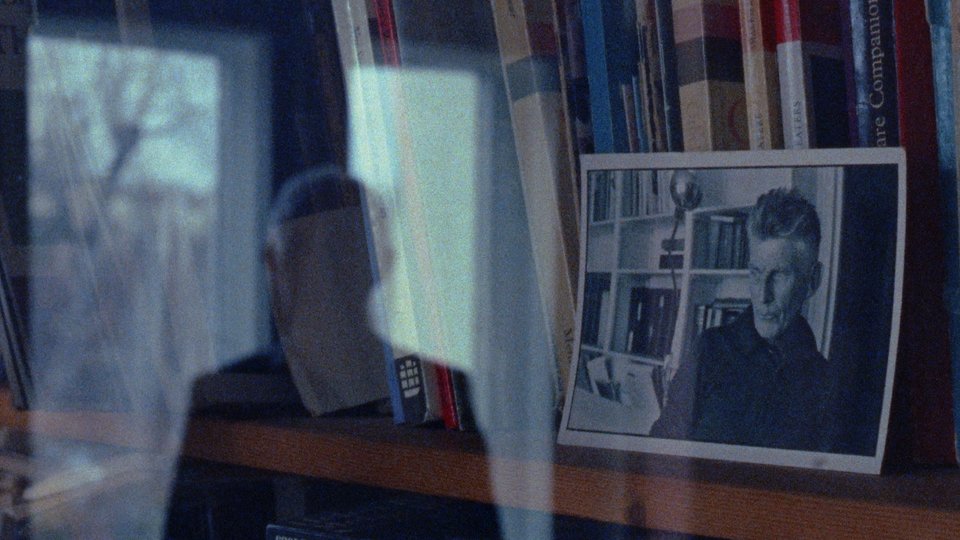
If I Fall, Don’t Pick Me Up – A New Film on Samuel Beckett in Germany
If I Fall, Don’t Pick Me Up, a film from Irish filmmaker Declan Clarke, explores the relationship between iconic Irish author Samuel Beckett and renowned German theatre director Walter D. Asmus, and considers a legacy built on interpretation and performance: when the original actors have departed the stage, what remains?
Legacies intertwined
Beckett and Asmus met in the early 1970’s and worked closely together for the last fifteen years of Beckett’s life.
The film, shot entirely on 16mm film, reflects on their developing relationship through the written communications Beckett sent to Asmus - at first succinct and professional, but progressively more personal.
The true depth of their connection is more extensively relayed through the annotated theatre notes that were developed as Asmus directed Beckett’s work through the 1970s and 80s.
While Walter Asmus directed all of Beckett's plays internationally - with the exception of 'Play' and 'Catastrophe' - their work together to bring, interpret, and present 'Waiting for Godot' to the stage is the most enduring legacy of their working relationship.
In 1988 Asmus directed what has come to be regarded as the definitive version of Beckett’s landmark play Waiting for Godot at The Gate Theatre, Dublin.
Irish film debut
The film, which had its Irish premiere at the Cork International Film Festival, was commissioned by the Embassy of Ireland in Germany to explore this cultural link. It is part of Zeitgeist Irland 24, a joint initiative of Culture Ireland and the Embassy to bring a season of Irish culture across Germany in 2024.
If I Fall, Don’t Pick Me Up received the Jury’s Special Mention at the prestigious international film festival, FID Marseille and has also been shown at recognised film festivals in Munich, Lisbon, and Buenos Aires.
Here, film maker Declan Clarke answers questions on Beckett’s relationship with Germany and Walter Asmus as well as the process of making the film.
If I Fall, Don't Pick Me Up - Trailer
Q&A with Filmmaker Declan Clarke
Q: Beckett had a particularly strong relationship with Germany. Why do you think that was the case?
A: I'm not sure there's a clearly identifiable reason per se. There was his closeness to his German cousin in the late 1920's, which presumably made an initial contribution, with that being followed up by his time spent in the country in 1936-7.
The fact Beckett was greatly influenced by German music, literature and painting was probably the most significant factor in terms of its impact on his work. The meetings he had with German artists at this time, and in particularly how they (and their work) were being treated under National Socialism also made a lasting impression on him.
After the war, the sustained interest in his plays in particular led to his developing such a strong relationship with firstly the Schiller-Theatre and later the Süddeutscher Rundfunk, and by extension Walter Asmus. I think all of these factors combined to produce Beckett's relationship with Germany.
Q: What did it mean to you to make this film?
A: It meant an enormous amount to me to make this film. Beckett has been a huge influence on me personally since I saw Waiting for Godot at the Gate Theatre as a sixteen-year-old in 1991. This was, of course, directed by Walter Asmus.
When I met Walter for the first time - on Bloomsday 2022 as it so happens - I was greatly moved. I told him that I stood before him as an artist and filmmaker because of the impact the experience of seeing his Godot production had on me. To meet him was profoundly affecting.
To then be able to work with Walter, and for me to direct him on the stage of The Gate theatre, around the same Godot set I had seen in 1991 was both absurd and humbling. An unforgettable and barely comprehensible experience.
Q: Can you tell us a little about the process of the making of this film and how it developed throughout.
A: The process began simply enough: [the Embassy’s Head of Cultural Affairs] Candice Gordon asked me would I make a film about Walter Asmus and Samuel Beckett, and I said yes. However, I also said that I could only make the film in my own way.
We met with Walter, and I explained to him that I wanted to make a film that Samuel Beckett would want to watch, rather than a film 'about' Beckett. Walter seemed to concur with that approach, and then, later, he and I spent some time together going through his archive.
I felt like Howard Carter - "I can see wonderful things" - as Walter shared with me the letters, postcards, manuscripts, photographs and recollections of the extraordinary work he and Beckett did together. I floated home.
Q: You use the letters between the two men to explore their increasingly friendly relationship over several years. What did you find out about their relationship with one another?
A: The most significant thing I found out about their relationship was that it was grounded first and foremost in the work. A deep and true friendship and understanding followed, but this emerged, I believe, because Walter had a deep and true understanding of Beckett's work.
Q: What do you think is the legacy of their partnership over many years?
A: Beckett needed Walter, and so do we. Without Walter Asmus, we wouldn't have the understanding and access to Beckett's work that we are extremely fortunate to have due to their mutual commitment to the work above all else. That is a tremendous legacy.
Q: The film has had a very positive reception, including a Special Mention at FID Marseille. Have you been pleased with its reception?
A: I've been extremely pleased with the reception the film has had, but I must say, the reception that pleased me most was that of Walter Asmus. We shared something very special in the making of this film, and that I cherish deeply.