


Sounds of Ireland: Four maestros showcasing Ireland’s musical heritage
An island of diverse musical traditions, Irish music spans the gambit from the haunting beauty of ancient Celtic melodies to the innovative composition of contemporary Irish artists.
The talent and creativity of Irish people combined with a rich cultural heritage make Ireland a global hub for music. Explore some of the voices and instruments that carry the spirit of Ireland across borders and generations, and the powerful connections that are built playing music together, in London and beyond, through the music maestros below:
Niamh O’Donoghue - Fiddle
Dublin-born Niamh O’Donoghue is a journalist, sustainability activist and Global Head of Social at Stella McCartney. Growing up, she was inspired by the music that surrounded her and her family and she has been playing the fiddle since early childhood.
The fiddle is almost an identical instrument to the violin, but it is the style of playing which differentiates the instruments. The fiddle plays a core role in Irish traditional and folk music, and tunes are often passed down through the aural “by ear” tradition rather than via written music, as is the case with the violin.
Compared with the classical violin, fiddle players tend to use less vibrato and long notes, and instead prefer to use a more upbeat style of playing, making it the perfect accompaniment to dancing. Fiddle players often embellish melodies with their own ornamentation and so each performance is unique.
During the 17th century there was gradual decline in the harp’s importance due to the displacement of the Irish upper-class. The fiddle, which was seen as practical and functional, grew in popularity and has thrived in Irish music ever since.
Thanks in part to musical legends such as Sean Ó’Riada, organisations like Comhaltas Ceoltóirí Éireann, and now contemporaries like Niamh, the fiddle has long remained the heartbeat of Irish traditional music.
Amy Gillen - Flute
Donegal native Amy Gillen graduated from the Royal Irish Academy of Music and the Royal College of Music London. She is not short of musical talent, as a flutist, singer-songwriter/composer, pianist, producer and teacher.
The flute holds a central place in Irish traditional music, celebrated for its distinctive, mellifluous tone that captures the spirit and history of Ireland’s folk heritage.
This instrument has been integral to Irish music since the 19th century, offering a unique voice that complements the lively dance rhythms and plaintive airs characteristic of the genre.
Its versatility allows it to lead sessions or to evoke deep emotion. The flute’s prominence is also reflected in its rich repertoire and the notable musicians who have contributed to its enduring legacy, ensuring its place as a beloved and essential element of Irish cultural expression.
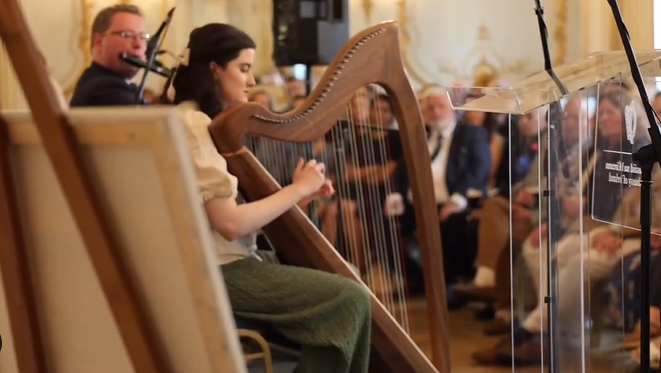
Tara Viscardi - Harp
Hailing from the Beara Peninsula in the south west of Ireland, Tara Viscardi graduated from the Royal College of Music in 2021 with a Masters of Music in Performance and also holds a Postgraduate Diploma in Harp Performance from the Civica Scuola di Musica Claudio Abbado, Milan. Tara performs on Irish traditional, classical and baroque harps and is a composer, collaborating with artists across many genres.
The harp holds a place of profound significance in Irish music and culture. As Ireland’s national emblem, the harp is deeply intertwined with the country’s history, and is often played on state occasions. The instrument’s cultural importance is also evident in its presence on Irish currency, official documents, and monuments, serving as a reminder of Ireland’s enduring cultural legacy.
A stringed instrument with a distinct, melodious sound, the harp brings an enchanting quality that much traditional Irish music is known for. A key aspect of how the Irish play the harp is found in how it is plucked – with fingernails rather than fingertips, to produce bright, bell-like tones.
While an ancient instrument, the harp lives on in modern music by incorporating elements of other musical styles, from jazz to classical music, and is part of a vibrant traditional music scene, as well as exciting contemporary composition.
Rita Farrell - Uilleann Pipes
London-born Rita Farrell was strongly influenced by her multi-instrumentalist Irish parents who are from Co. Leitrim and Co. Louth. Holidays to Ireland during the summer comprised of many music festivals where she developed a great love for traditional Irish music. Her love of the uilleann pipes started from a young age and earned her a Na Píobairí Uilleann (the Society of Uilleann Pipers) Scholarship.
The uilleann pipes – translating literally to ‘pipes of the elbow’ – are the bagpipes of Ireland. In 2017, UNESCO inscribed uilleann piping into their Representative List of the Intangible Cultural Heritage of Humanity, illustrating the instrument’s contribution to music. The manufacturing of the pipes requires a high level of craftsmanship and each set of uilleann pipes are bespoke, meaning that no two uilleann pipes are identical. Rita plays a very unique set made by Sam Lawrence of Hunter Pipes.
In their early days, the uilleann pipes were an instrument of the wealthy class. However, the instrument was popularised by pipers such as Johnny Doran, James Gandsey and Paddy Conneely who attracted large audiences. At the beginning of the 20th century, pipers clubs grew in size due to influential figures such as Éamonn Ceannt, who led the Dublin Pipers club Na Píobairí Uilleannwhich is still thriving today.
The uilleann pipes today are practiced by about 6,000 people around the world, who are bound together by a shared love of this uniquely haunting and beautiful instrument.