


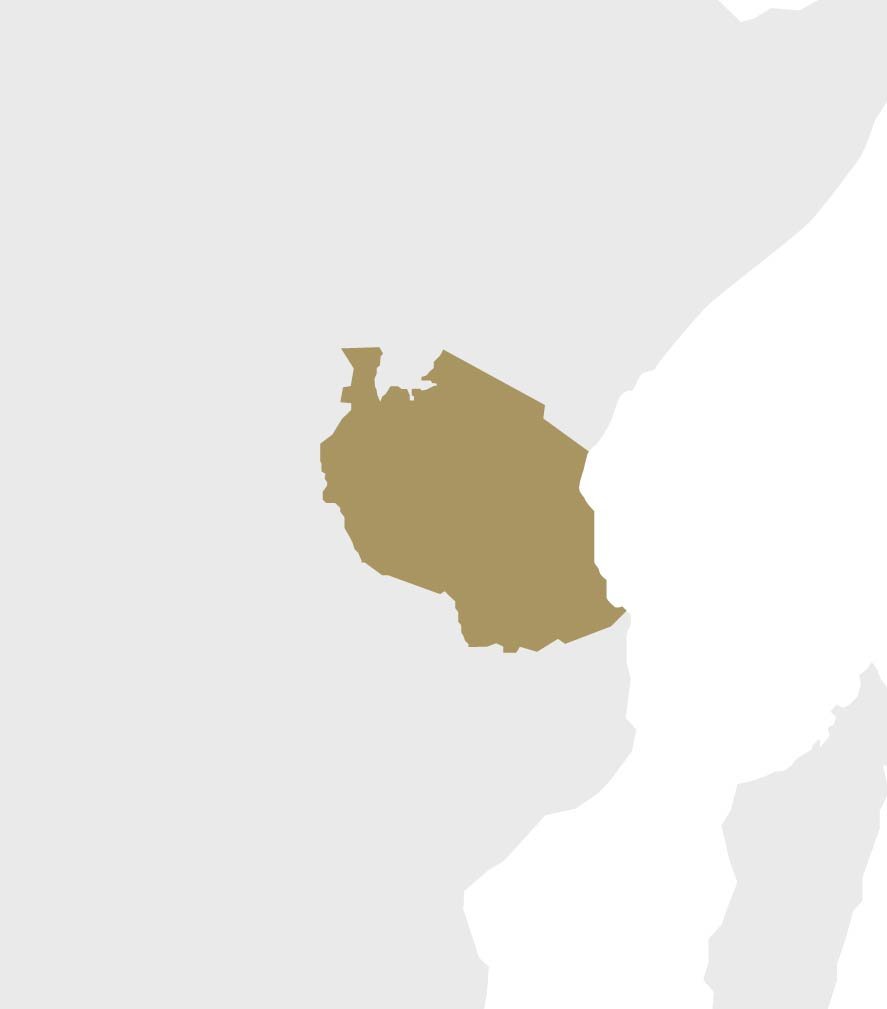
The United Republic of Tanzania is a vast country in East Africa, with a population of over 6 million. With approximately 125 spoken languages, Tanzania is very diverse.
The United Republic of Tanzania gained independence in 1961. It has a population of around 67.5 million, making it the most populous country located south of the equator.
The country is a presidential constitutional republic with the federal capital located in Dodoma. The former capital, Dar es Salaam, still retains some government offices and is the country's largest city, principal port, and leading commercial centre. For decades, Tanzania has been ruled by the Chama Cha Mapinduzi (CCM) party.
Tanzania’s rich resource base and relative stability have resulted in a growing economy. The country has recently been identified as having lower middle income status. Improved access to social services has contributed to improved health and education. However, challenges remain and the World Bank notes that the elasticity of poverty reduction to growth has been low.
Other challenges include persistent rural poverty due to issues like climate variability and the lack of access to resources. Vulnerable populations including women and people with disabilities remain at risk.
Ireland’s work in Tanzania
Ireland has been working in Tanzania since 1968. This work involves partnering with the Tanzanian government, European Union, United Nations, and NGOs.
Ireland continues to develop its political, economic, trade, development and cultural relationships with Tanzania.
Ireland's development work in Tanzania covers five key areas:
Governance and promotion of human rights
Through partnerships with local civil society organisations and UN agencies, Ireland supports advancement of human rights, access to justice, and women’s political participation and leadership in Tanzania.
Climate action
Tanzania is vulnerable to the impacts of climate change. Its ecosystems, water, agriculture, and food security have all been affected. Climate action and the blue economy are key focuses for Ireland in Tanzania.
For example, Ireland works to improve the incomes of coastal communities in Tanga and Pemba and to enhance conservation of the coastal and marine ecosystem and biodiversity.
Ireland’s work helps to promote sustainable fishing. It also aims to increase transparency and improve governance in fisheries.
Food and sustainable food systems
Agriculture, forestry, and fishing are amongst the largest economic sectors. These sectors account for 27% of GDP and the employment of a majority of Tanzanians, but the rate of growth is low. Economic growth has come from manufacturing, mining, services, construction, and tourism.
Over 50% of people in Tanzania live in rural areas. Poverty is severe in many regions where people rely on agriculture for income. People are vulnerable to drought and food price fluctuations.
Ireland’s support for climate-smart agriculture in central Tanzania is yielding strong results. Working with the World Food Programme (WFP), we promote drought resistance crops. This helps farmers to diversify their production, increasing income and nutrition.
Gender equality
Promoting gender equality is central to Ireland's work in Tanzania. Women are disproportionately affected by poverty and hunger. Ireland helps to improve access to reproductive health services for women and girls. Ireland also supports community nutrition programmes.
In partnership with UN agencies, Ireland contributes to strengthening coordination and coherence of gender equality and women’s empowerment interventions in Tanzania.
As with many countries around the world, gender-based violence remains problematic in Tanzania. Ireland supports access to justice for people who have experienced gender-based violence. We do this through partnership with the UNDP’s (United Nations Development Programme) Legal Empowerment and Access to Justice in Zanzibar (LEAP) programme.
Furthest left behind
Tanzania has been a country of refuge for people seeking international protection. According to the UN Refugee Agency (UNHCR), there were over 200,000 refugees in Tanzania by mid-2025. Most of these refugees are from Burundi and the Democratic Republic of the Congo (DRC).
Ireland supports services for refugees in north-western Tanzania. These services help to provide livelihoods, food, health care, and gender-based violence response services.
Supporting health services
Support to the health sector is a priority for Ireland in Tanzania. We focus on strengthening access to primary health care services, including reproductive, maternal, and new-born child health services, and support over 6,780 local primary health facilities across the country.
Ireland also continues to provide support to the Tanzanian NGO Tumaini La Maisha (TLM) to support childhood cancer services in Tanzania. This is part of an ongoing collaboration between TLM, Muhumbili National Hospital, Crumlin Hospital, and other Irish hospitals.